
Introduction: When One Small Change Creates a Big Problem
In digital publishing, a single content update can have consequences far beyond the sentence being edited. A revised figure, an updated reference, a corrected author name, or a change to a scientific statement may need to be reflected across multiple files, review stages, and publishing platforms. If even one version is overlooked, the published content can become inconsistent or inaccurate.
As publishers increasingly manage digital-first workflows, frequent revisions have become a routine part of content production. Manuscripts move between authors, editors, proofreaders, designers, quality control teams, and production specialists. Each stage may generate a new file or introduce additional changes. Without a reliable version control process, teams can lose track of which document contains the latest approved content.
This creates an important challenge for modern publishing: how can publishing teams manage continuous content updates without compromising accuracy, consistency, or editorial quality?
Understanding version control and implementing structured content management practices can help publishers reduce errors, improve collaboration, and maintain confidence in every published version.
On This Page
What Is Version Control in Digital Publishing?
Version control is the systematic process of tracking, organizing, reviewing, and managing changes made to a document or digital content asset over time. It helps publishing teams identify what has changed, who made the change, when it occurred, and whether the updated version has been reviewed and approved.
In traditional publishing workflows, teams may rely on filenames, email attachments, shared folders, or manual revision tracking to manage document changes. These methods can work for small projects, but they become increasingly difficult to manage when several people edit the same content or when multiple publications are processed simultaneously.
Digital publishing involves more than maintaining a final manuscript. A single publication may include the original submission, edited manuscript, author corrections, page proofs, final publication files, supplementary materials, metadata, and online content. Changes to one component may require corresponding updates elsewhere.
For example, if an author corrects a table value during proof review, the publishing team may need to verify that the value is consistent in the main text, figure captions, supplementary files, and any related online material. Without a clear record of changes, an outdated value could remain in the final publication.
Effective version control ensures that each stage of the publishing process has a clearly identified version, an appropriate approval status, and a traceable history of changes.
Why Version Control Has Become More Challenging
1. Multiple Contributors Working on the Same Content
Digital publishing is a collaborative process. Authors, editors, proofreaders, designers, subject specialists, and production teams often work on the same document at different stages.
When revisions are exchanged through email or shared folders, multiple copies can quickly accumulate. One editor may work on an earlier file while another team member has already incorporated new corrections. Both documents may appear valid, making it difficult to determine which version should move forward.
This problem becomes more serious when deadlines are tight and several contributors are working in parallel.
A structured version control process helps establish a single authoritative working version, clear ownership of changes, and a defined method for incorporating revisions.
2. Frequent Author Revisions and Late Corrections
Authors may request changes after editorial review, during typesetting, or even after proofs have been generated. These updates may involve factual corrections, revised terminology, reference changes, updated affiliations, or modifications to tables and figures.
Not all late changes carry the same level of risk. Correcting a typographical error may be straightforward, while changing a numerical result or scientific statement may require additional verification and approval.
If late revisions are accepted without documenting their scope, teams can overlook related content or accidentally reintroduce errors that were corrected earlier.
Publishers need a consistent process for receiving, evaluating, approving, and implementing late-stage changes. This ensures that necessary corrections are handled carefully without creating unnecessary disruption to production.
3. Inconsistent Content Across Different Formats
A publication may be distributed as a web article, PDF, EPUB, XML file, or other digital format. Depending on the publishing workflow, each format may be generated from a shared source or maintained through separate production steps.
When content is updated in one location but not propagated to related outputs, inconsistencies can emerge. A corrected heading might appear on the website but remain unchanged in a downloadable file. Updated metadata may not match the information displayed in the article itself.
These discrepancies can affect reader trust, accessibility, discoverability, and the reliability of published information.
A well-designed workflow should identify which assets depend on a particular content change and ensure that all affected outputs are regenerated, reviewed, or updated as required.
4. Limited Visibility Into Change History
Knowing that a document has changed is not always enough. Publishing teams also need to understand what changed and why.
Without a reliable change history, editors may struggle to distinguish an approved correction from an accidental modification. Reviewers may need to compare entire documents to identify a single altered sentence, while production teams may find it difficult to confirm whether author queries have been resolved.
This can lead to repeated work, delayed approvals, and avoidable quality issues.
Maintaining a traceable record of revisions allows teams to review differences between versions, identify the person responsible for a change, and confirm whether the change has passed the required checks.
The Risks of Poor Version Control in Publishing
Weak version management affects more than document organization. It can directly influence the quality and reliability of published content.
Editorial inaccuracies: Outdated statements, incorrect references, unresolved comments, or previously corrected errors may reappear in later versions.
Production delays: Teams spend additional time comparing files, requesting clarification, repeating edits, and confirming which version is approved.
Compliance and traceability concerns: In scholarly, scientific, medical, technical, and regulated publishing, teams may need to demonstrate how important corrections were reviewed and approved. Inadequate records make that process more difficult.
Damage to reader confidence: Inconsistent information across publication formats can undermine the credibility of a publisher and create confusion for readers.
Higher operational costs: Rework, repeated quality checks, and delayed publication schedules consume time and resources that could be directed toward other editorial and production activities.
These risks demonstrate why version control should be treated as an essential component of publishing quality assurance rather than simply a file-management task.
Best Practices for Managing Content Updates Accurately
Establish a Single Source of Truth
One of the most effective ways to reduce version confusion is to establish a clearly defined authoritative source for each publication.
Instead of allowing contributors to maintain disconnected copies, publishing teams should use an agreed document repository or content management system. Access permissions and workflow rules should make it clear which version is active and where approved changes must be recorded.
A consistent naming convention can provide additional clarity. File names may include a manuscript identifier, version number, date, or workflow stage, where appropriate.
However, naming conventions alone are not sufficient. Teams should also maintain clear status labels, such as In Editing, Awaiting Author Approval, Proof Review, and Final Approved. This reduces the risk of an older file being mistaken for the approved version.
Track Changes and Record Decisions
Every meaningful revision should be traceable. Document comparison tools, tracked changes, review comments, and version histories help teams identify modifications without manually checking every line.
For important corrections, teams should record the reason for the change, the person responsible, and the approval status when required by the workflow.
A documented decision is particularly valuable when an edit affects technical terminology, numerical data, citations, author information, or the interpretation of research findings.
The objective is not to create unnecessary administration. It is to ensure that important decisions can be understood and verified later.
Introduce Clear Review and Approval Checkpoints
Content should not move from one production stage to another without a defined understanding of its status.
For example, an author-approved manuscript should not automatically be treated as the final production file if subsequent corrections are still pending. Similarly, a proof containing unresolved author queries should not be marked as ready for publication.
Publishers can introduce checkpoints at manuscript submission, editorial review, copyediting, author proof review, final quality control, and publication release.
Each checkpoint should specify what needs to be checked, who is responsible, and what conditions must be met before the content advances.
Use Automated Quality Checks Where Appropriate
Automation can help identify discrepancies that might otherwise escape manual review. Depending on the publishing system, automated checks can flag missing metadata, broken links, inconsistent terminology, unresolved comments, formatting irregularities, and differences between structured content and rendered outputs.
For XML-based workflows, validation can help identify structural or schema-related issues before publication. Automated comparison tools can also highlight differences between approved source content and generated files.
However, automation should support—not replace—editorial judgment. A system can detect that a value has changed, but a qualified reviewer may still need to determine whether the change is factually correct and appropriately authorized.
Maintain Consistency Across Publishing Formats
Publishers should define how changes move from the authoritative content source to each publication format.
Where possible, using structured content and repeatable production workflows can reduce the need to update separate files manually. If multiple outputs are generated from the same approved source, teams can reduce duplication and improve consistency.
Before release, quality control should verify the relevant outputs, including text, tables, figures, references, metadata, and supplementary files. The extent of these checks should reflect the publication type and the significance of the changes made.
Define Responsibilities for Every Stage
Version control works best when responsibilities are explicit. Authors may be responsible for confirming factual corrections, editors for editorial decisions, production teams for implementing approved changes, and quality control specialists for verifying final outputs.
Clear ownership prevents conflicting edits and helps ensure that important changes are not left unresolved between departments.
A defined escalation process is also useful when a late correction affects content that has already been approved or published.
How Technology Is Improving Version Control in Digital Publishing
Modern publishing platforms can bring content storage, revision history, review workflows, permissions, and approval tracking into a more coordinated environment.
Content management systems can help teams organize assets and manage their publication status. Document comparison tools can highlight changes between revisions, while workflow automation can notify the appropriate contributors when a review or approval is required.
Structured content technologies, including XML-based publishing workflows, can support consistent content reuse and the generation of multiple output formats. When implemented effectively, these approaches reduce repetitive manual updates and make it easier to maintain a connection between source content and published outputs.
Artificial intelligence can also assist with selected quality assurance tasks, such as identifying possible inconsistencies, comparing document versions, flagging terminology variations, and detecting missing elements. Nevertheless, AI-generated flags should be reviewed by qualified publishing professionals, especially when changes affect scientific accuracy, factual claims, or sensitive information.
The most effective solution depends on the publisher’s content volume, publication types, team structure, technical requirements, and existing systems. Technology delivers the greatest value when it supports a clearly defined editorial process rather than attempting to compensate for an inconsistent one.
Building a Reliable Version Control Workflow
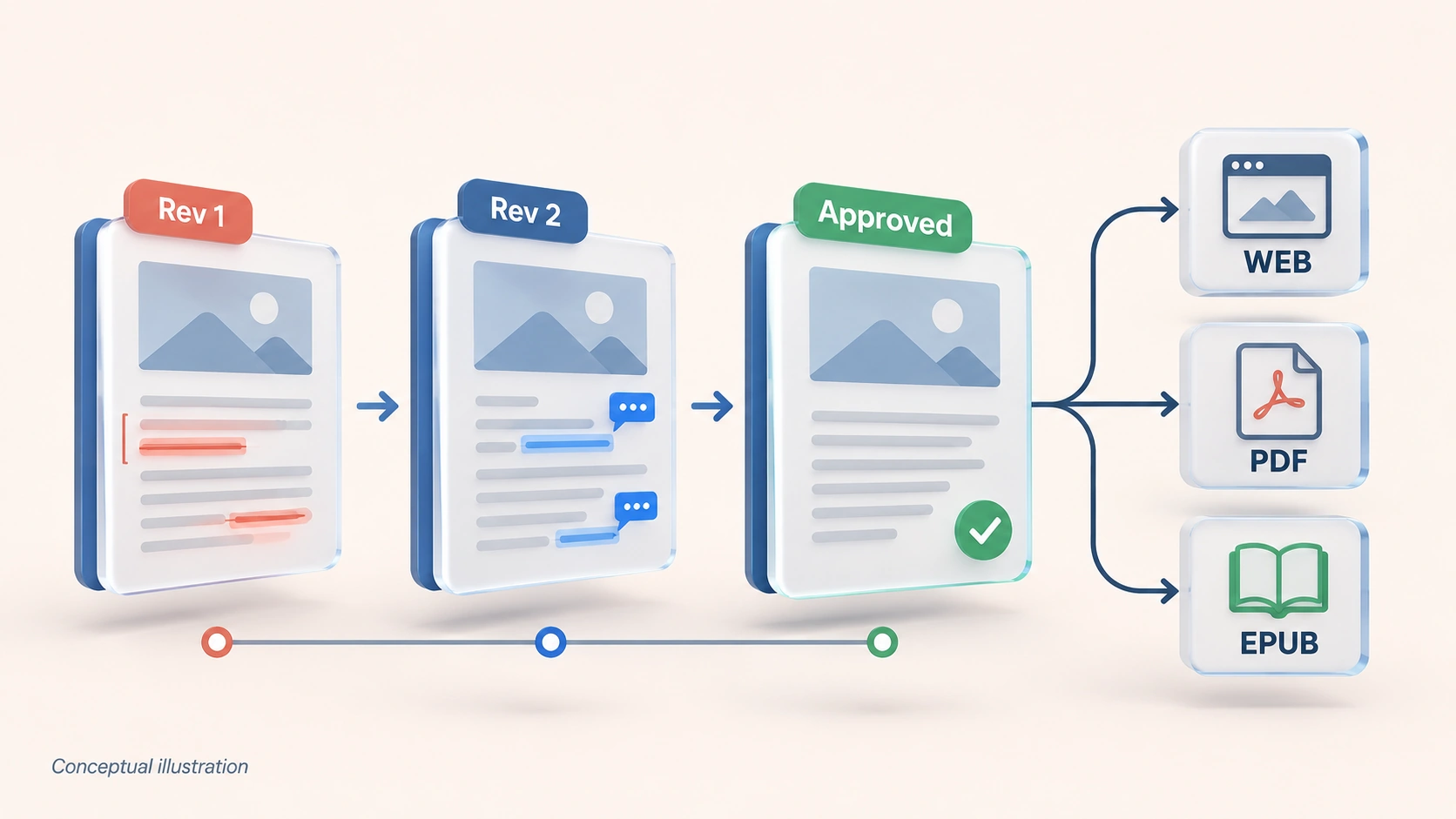
A practical version control workflow should connect content creation, review, approval, and publication through a consistent sequence of steps.
First, establish the authoritative manuscript or content source and assign a unique identifier. Next, record revisions as they are received and ensure that the appropriate reviewer evaluates each change. Once approved, incorporate the revision into the designated working version and update any dependent content or publication outputs.
Before publication, verify that all required approvals are complete, significant changes have been checked, and the final outputs accurately reflect the approved content. After release, retain the necessary version history and follow the publisher’s established correction and update policy.
This process should be proportionate to the publication. A short marketing article may require a lightweight review and approval system, while a scientific journal article or technical publication may need more extensive traceability and verification.
The goal is to make the correct version easy to identify, approved changes easy to trace, and content errors less likely to reach readers.
The Future of Version Control in Digital Publishing
As digital content becomes more dynamic, version control will increasingly be connected to broader publishing operations, including structured content management, automated quality assurance, collaborative editing, and multi-format distribution.
Publishers will need workflows that support frequent updates while preserving accountability and editorial integrity. The challenge will not simply be to process changes faster, but to ensure that every change is appropriate, authorized, and consistently reflected wherever the content appears.
Combining clear editorial standards with suitable publishing technology can help organizations reduce rework, improve production efficiency, and maintain reliable content across the publication lifecycle.
Conclusion
Version control is a fundamental part of accurate digital publishing. When multiple contributors, frequent revisions, and different output formats intersect, even a small oversight can create inconsistencies that affect the quality of the final publication.
By establishing a single source of truth, tracking revisions, defining approval checkpoints, automating appropriate quality checks, and assigning clear responsibilities, publishing teams can manage content updates with greater confidence.
Ultimately, successful digital publishing is not just about delivering content quickly. It is about ensuring that every published version reflects the correct information, the approved changes, and the editorial standards readers expect.
Related reading: