
Introduction: When Content Looks Convincing, Is It Correct?
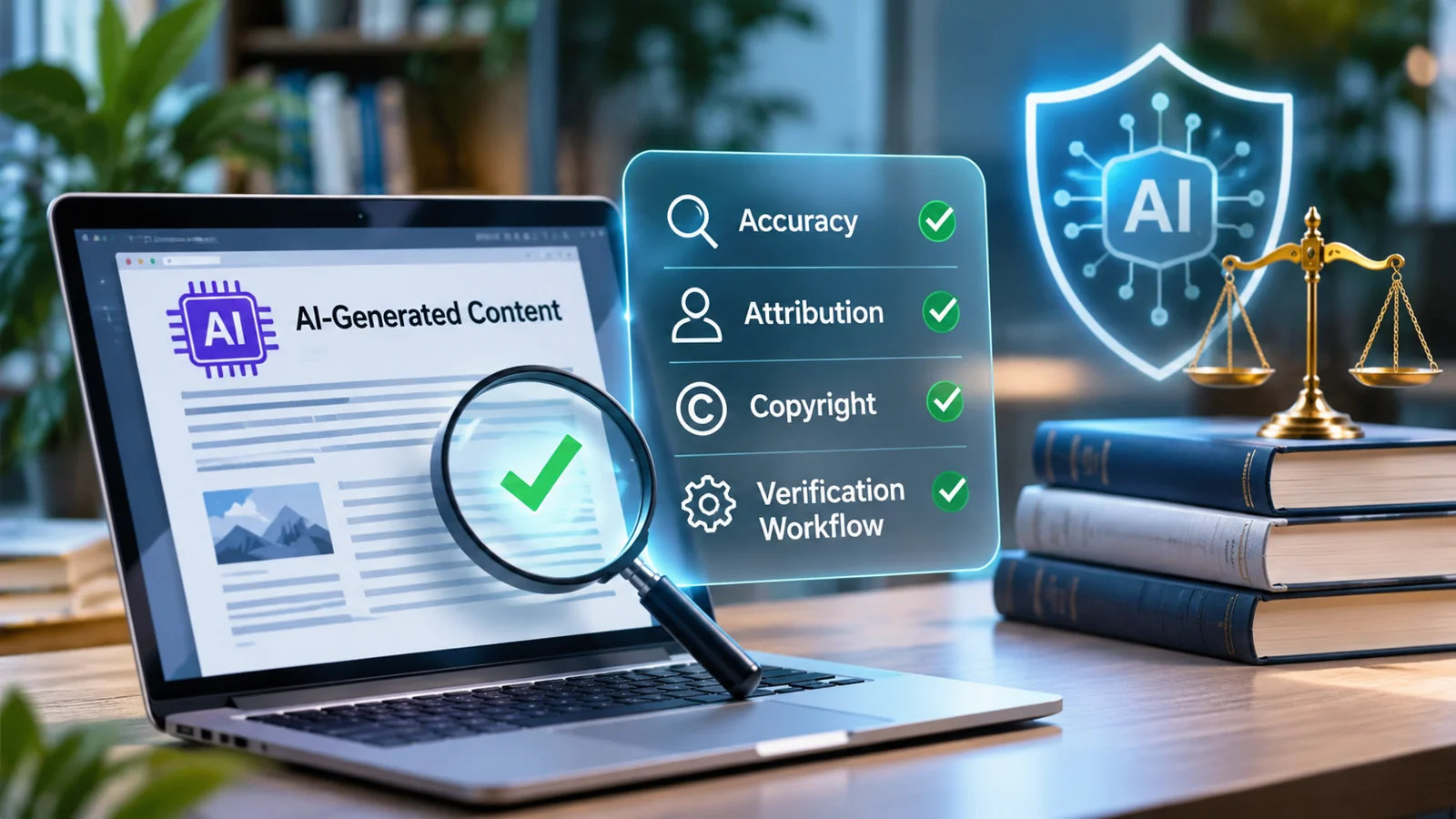
An AI content verification workflow helps publishing teams check accuracy, attribution and copyright before material is released. Artificial intelligence is changing how content is researched, written, edited, summarized, and published. From generating first drafts to improving readability and assisting with research, AI tools are becoming part of everyday publishing workflows. They can help teams work faster, explore ideas, and manage large volumes of information.
However, polished writing does not necessarily mean reliable information. AI-generated content can contain inaccurate facts, fabricated references, misleading interpretations, or statements that lack adequate supporting evidence. It may also reproduce language resembling existing material or introduce copyright and attribution concerns that are difficult to identify through ordinary proofreading.
For publishers, the challenge is no longer simply deciding whether AI should be used. It is determining how AI-assisted content can be evaluated before it reaches readers.
Can AI-generated content be trusted? The answer depends on how carefully it is verified, reviewed, and approved.
A structured verification workflow can help publishers benefit from AI while protecting factual accuracy, intellectual property, transparency, and editorial credibility.
On This Page
Understanding the Risks of AI-Generated Content
AI systems generate responses based on patterns learned from data and the instructions they receive. They can produce fluent, well-organized content, but they do not guarantee that every statement is true or that every source is genuine.
Several risks deserve particular attention in publishing.
1. Factual Inaccuracies and Fabricated Information
AI-generated content may include incorrect dates, statistics, technical explanations, quotations, names, or research findings. It can also produce references that look authentic but contain incorrect titles, authors, publication details, or identifiers.
These errors may be difficult to recognize because they can appear within otherwise accurate and professional writing.
In general publishing, an incorrect claim can mislead readers or damage a publisher’s reputation. In scientific, medical, legal, and technical publishing, unsupported information may have more serious consequences.
The appropriate response is to verify factual claims against reliable primary sources or authoritative references rather than relying on the confidence or fluency of the generated text.
2. Weak or Misleading Attribution
AI tools may summarize information without clearly identifying where it originated. A generated paragraph might combine ideas from several sources, omit important qualifications, or present established knowledge without indicating which claims require citations.
In scholarly publishing, this can create problems with citation accuracy, attribution, and the distinction between an author’s original contribution and previously published work.
A reference list alone does not establish that a manuscript has properly attributed its claims. Editors must check whether cited sources actually support the statements associated with them and whether quotations, paraphrases, and borrowed ideas are appropriately acknowledged.
3. Copyright and Intellectual Property Concerns
Copyright questions surrounding AI-generated content can be complex. They may involve the material supplied to an AI system, the content produced by that system, the reuse of existing text or images, and the rights associated with the final publication.
The legal position varies by jurisdiction, the circumstances of use, and the applicable agreements. The use of an AI tool does not automatically establish that generated material is free from copyright concerns, nor does similarity alone prove infringement.
Publishers should therefore assess whether content contains potentially unauthorized reproductions, whether third-party material has been used with appropriate permission or licensing, and whether the contributor has the necessary rights to submit and publish the work.
4. Loss of Context and Meaning
AI tools can shorten complex explanations, simplify technical terminology, and summarize lengthy documents. However, these transformations can remove essential context or alter the meaning of the original material.
For example, a summary of a research paper might emphasize a positive result while omitting limitations, uncertainty, or the conditions under which the finding was observed.
In editing and academic publishing, preserving meaning is as important as improving readability. Any AI-assisted revision that changes technical statements, research conclusions, quotations, or numerical information should receive appropriate human review.
Building a Reliable AI Content Verification Workflow
An effective verification process should begin before publication and continue through editing, approval, and final quality control. The exact checks will depend on the type of content, its intended audience, and the consequences of an error.
Step 1: Establish Clear Rules for AI Use
Publishers should define which AI applications are permitted, which tasks require approval, and which activities must remain under direct human control.
For example, AI may be used to suggest headings, improve grammar, summarize material, or assist with preliminary research. More sensitive tasks, such as generating scientific interpretations, modifying research results, creating realistic images of evidence, or drafting claims that require specialist expertise, may require stricter controls.
Policies should also explain how contributors must disclose AI assistance when required by the publisher’s guidelines, journal policies, contracts, or applicable standards.
Clear rules reduce uncertainty for authors, editors, reviewers, and production teams. They also help distinguish acceptable editorial assistance from uses that could compromise research integrity or publication ethics.
Step 2: Verify Important Factual Claims
Factual verification should focus on claims that materially affect the content’s accuracy and credibility.
Editors should check names, dates, numerical values, quotations, technical statements, statistics, and other claims against reliable sources. Where possible, primary sources should be preferred over summaries or secondary descriptions.
For scholarly content, references should be checked to confirm that the cited work exists, its bibliographic details are accurate, and the relevant passage supports the manuscript’s claim.
Automated tools can help identify suspicious references, missing citations, or inconsistencies. However, a successful automated check does not necessarily establish that a source supports the claim. Human assessment remains necessary for context and interpretation.
Step 3: Check Attribution and Originality
Originality checking and citation verification serve different purposes. Similarity-detection software can highlight matching text, but it cannot independently determine whether the use is appropriate, whether a quotation is properly attributed, or whether an apparent match constitutes infringement.
A reliable workflow combines similarity reports with editorial judgment. Reviewers should examine the source of matched passages, assess the context, and determine whether quotation marks, citations, permissions, or revisions are needed.
AI-generated paraphrasing should not be treated as a substitute for attribution. If an idea, finding, or argument comes from another source, its origin may still need to be acknowledged even when the wording has changed substantially.
Step 4: Review Copyright and Content Ownership
Before publication, teams should confirm that the material can be used in the intended context.
This may include checking permissions for images, tables, diagrams, long quotations, and other third-party assets. Publishers should also review the terms governing relevant AI tools and consider whether confidential or unpublished content has been submitted to systems that are unsuitable for that information.
For AI-generated text or images, teams should document the tool used and the nature of its contribution when appropriate. They should also consider applicable copyright law, licensing conditions, journal requirements, and contractual obligations.
Where the legal status is uncertain or the potential impact is significant, specialist legal advice may be appropriate.
Step 5: Introduce Human Review at Critical Points
AI tools can assist with checking content, but they should not be the sole authority for approving high-impact claims.
Human reviewers provide contextual understanding, subject expertise, and editorial judgment. They can identify when a technically plausible statement misrepresents a source, when a revision changes the author’s intended meaning, or when a copyright concern requires further investigation.
The level of review should be proportionate to risk. A routine grammar correction may need only a light check, while a change to a medical recommendation, research conclusion, or legal claim may require review by a qualified specialist.
Step 6: Maintain an Audit Trail
A verification workflow is stronger when decisions can be traced.
Depending on the publication process, records may include the type of AI assistance used, the relevant source checks, corrections made, permissions obtained, reviewer approvals, and the final status of the content.
These records help teams understand how a concern was resolved and provide a reference if questions arise after publication.
Documentation should be practical rather than excessive. The aim is to preserve evidence of important decisions without creating unnecessary administrative work.
Can AI Detection Tools Identify AI-Generated Content Reliably?
AI-detection tools attempt to estimate whether a piece of writing may have been generated or substantially assisted by AI. However, their results can be uncertain, particularly when text has been edited, translated, shortened, or written in a style that resembles machine-generated language.
A detector’s score should not be treated as definitive proof of authorship, misconduct, or copyright infringement. False positives may unfairly raise concerns about legitimate authors, while false negatives may fail to identify AI-assisted content.
For publishers, it is more useful to assess the content itself and the evidence supporting it. Relevant checks may include source verification, citation accuracy, the author’s ability to explain the work, compliance with disclosure policies, and the consistency of the submitted material with the publication’s requirements.
When concerns arise, a fair review process should allow the contributor to provide clarification and supporting information before a decision is made.
Applying Verification Workflows Across the Publishing Lifecycle
AI verification should not be restricted to the final proofreading stage. Different checks are valuable at different points in the publishing process.
During content creation, contributors can record relevant sources and follow the publisher’s AI-use policy. During editorial review, editors can verify claims, examine citations, and identify unsupported statements. During copyediting and production, teams can check that revisions preserve meaning and that approved content remains consistent across formats.
Before publication, a final review should confirm that material corrections have been resolved, required permissions are in place, disclosures have been handled according to policy, and the final output reflects the approved version.
For publishers managing multiple content types, standardized checklists can help teams apply consistent principles without forcing every article through an identical process.
Measuring Whether the Workflow Works
A verification workflow should be evaluated using meaningful quality indicators rather than the number of AI checks performed.
Publishers may monitor the frequency of factual corrections, reference errors, unresolved permissions, repeated editorial issues, and post-publication amendments. They can also assess how long verification takes and whether particular stages create unnecessary delays.
These measures help identify recurring weaknesses. If reference errors frequently appear during final production, for example, the publisher may need an earlier citation-checking step rather than an additional last-minute inspection.
The goal is to build a process that improves reliability while allowing appropriate uses of AI to deliver genuine efficiency gains.
The Future of Responsible AI-Assisted Publishing
AI will continue to influence content creation, editorial operations, and digital publishing. As tools become more capable, publishers will need verification processes that evolve alongside them.
The strongest approach is unlikely to depend on one detector or a single automated platform. It will combine source validation, editorial expertise, copyright awareness, transparent policies, and proportionate human oversight.
Publishers that treat verification as a core part of the workflow can use AI more confidently without assuming that generated content is automatically accurate, original, or legally cleared.
Conclusion
AI-generated content can be useful, but trust must be earned through verification. Factual accuracy, attribution, copyright, and editorial responsibility cannot be guaranteed by fluent writing or automated detection alone.
By establishing clear AI-use policies, validating sources, reviewing originality and permissions, involving qualified human reviewers, and maintaining appropriate records, publishers can reduce avoidable risks and strengthen content quality.
The future of publishing is not simply about generating content faster. It is about ensuring that every piece of published content is accurate, responsibly attributed, appropriately reviewed, and worthy of readers’ trust.
Related reading: